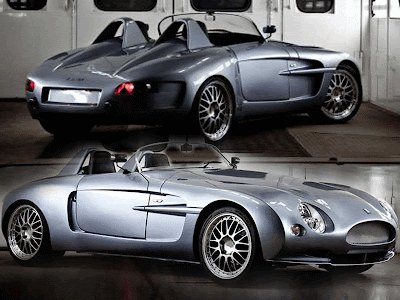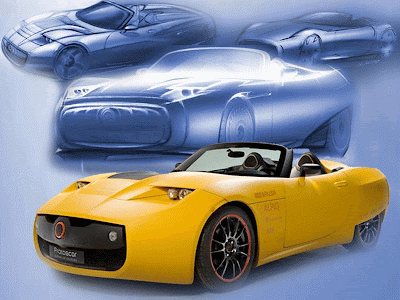
2010 LAMPO2 Electric Sports Car Protoscar Concept

LAMPO2 is an electric demonstration sports car conceived by Protoscar, a Swiss company which has been developing CleanCar projects for 23 years including consulting of OEMs, power utilities and governments. The LAMPO2 boasts 'quick-charging' capability (up to 100 km range extension in just 10 minutes charging time) and will be presented at the Geneva Motor Show (2nd March 2010) on the e'mobile stand Nr. 5141.
2010 LAMPO2 Electric Sports Car Protoscar Concept
LAMPO2 is an even more energy efficient successor to the LAMPO demonstration vehicle presented in 2009. Weight, aerodynamics and the efficiency of individual components of the BRUSA drive train have been further optimized in order to reach a world-class energy consumption of less than 100Wh/km-ton under real conditions. LAMPO2 is equipped with 4 different charging modes:
• standard single-phase with up to 3,3kW on board charger for typical overnight home-charge,
• 'control-pilot' equipped and (EDF provided) PLC single-phase with 6,6kW on board charger typical for public charging,
2010 LAMPO2 Electric Sports Car Protoscar Concept 
• standard three-phase 9,9kW on board charger typical for charging at industrial plugs (fleet-owners) and
• an interface for DC fast charging (able to transmit a max. power of 80kW), where up to 100km of additional range can be charged within just 10 minutes, by an off-board system, so that the different solutions can be compared in terms of usability and efficiency by being demonstrated in real conditions.
2010 LAMPO2 Electric Sports Car Protoscar Concept 
LAMPO2 will be shown together with different charging infrastructure solutions: a smart home charge device (developed with ALPIQ), the public charging station E-TOTEM and the quick-charging station (developed with ABB and Brusa).
2010 LAMPO2 Electric Sports Car Protoscar Concept 
LAMPO2 impressively demonstrates that electric drive-trains are mature and perform sufficiently well to be a solution for all types of vehicles, not just city cars. This includes premium cars, the segment through which most new technologies have successfully been introduced into the market.
2010 LAMPO2 Electric Sports Car Protoscar Concept 
Together with the first LAMPO (which has already been driven over 10'000 km on race tracks and public roads across Europe), LAMPO2 will be used for practical demonstrations and testing. Protoscar has repeatedly been encouraged to develop an advanced electric cabriolet for small-scale production and plans to use the LAMPO2 to evaluate this possibility. The evaluation will include discussions with potential industrial and financial partners, and an assessment of the preferences and desires of potential clients. Lampo crossing the Gotthard pass in May 2009.
2010 LAMPO2 Electric Sports Car Protoscar Concept 
In addition to BRUSA, which supplies the components of the whole drive train, the main partners and sponsors of the LAMPO2 project are ALPIQ (the leading Swiss company in power generation and distribution, which is actively promoting the goal of 15% of electric vehicles in Switzerland by 2020), the German Fraunhofer Institute IAO (EV-specific features and MMI, as well as optimization of the ergonomics), ABB (DC fast-charging technology) and the Swiss Federal Office of Energy.
2010 LAMPO2 Electric Sports Car Protoscar Concept 
Technical details LAMPO2 has two electric motors (allowing it to operate as a four-wheel drive with variable torque between front and rear axle for optimal handling, safety and efficiency) with a total output of 260 kW (equivalent to 350 HP), 600 Nm (50% more than its predecessor!) and over 30 kWh of Lithium-Ion battery capacity. LAMPO2 features real sports-car performances: 5 seconds to accelerate from 0 to 100 km/h, 200 km/h of max. speed and a range of over 200 km. More than enough energy for driving is produced by a remote solar plant which is installed on the roof of a farm in Tuscany, allowing a real zero-emission drive on a 'Well-to-Wheel' basis.

Source - Protoscar

Maserati Electric Supercar Tramontane Concept

Maserati Electric Supercar Tramontane Concept

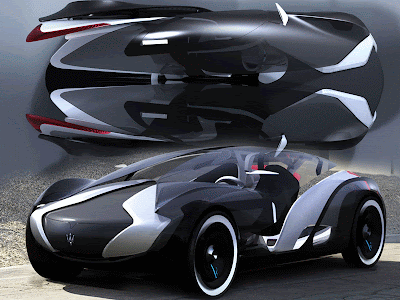
The Maserati Tramontane Concept is a luxury electric supercar with a futuristic design characterized by flowing elements that form different layers and interconnect the exterior and the interior. The author is Czech design student Ondrej Jirec.
The Maserati Tramontane is a lightweight electric luxury supercar with an original design focused on the reduction of the total number of body parts and the simplification of the production process by combining exterior and interior elements.
Maserati Electric Supercar Tramontane Concept 

Aside from the slippery, aerodynamic overall shape, the most eye-catching aspect of the concept's design is the number of components and body panels which flow from the interior to the exterior. These body parts have different functions, color, material and characteristics which are designed to add different dimensions and effect the overall feel of the vehicle.
Maserati Electric Supercar Tramontane Concept 

It was created by Czech student Ondrej Jirec for his Alias class at the Art Center College of Design. Among the distinctive features of the Maserati Tramontane's design are the components and body panels which flow from the interior to the exterior. These parts have different function, color, material and characteristics and create layers that add different "dimensions" and define an original design language.
The first layer is the main glass exterior surface that essentially envelops the entire car. It is supported by a black frame which attaches to the chassis.
Maserati Electric Supercar Tramontane Concept 

The second layer is composed of the headlamps and the dashboard. This single piece carries the LED headlights and flows smoothly back into the interior where it protects the speakers and interior air vents.
The third layer of the Tramontane creates the lower sections of the seats and, as it reaches the exterior, also carries the taillights. This particular part possesses very high resistance to impact. In case of side impact the seat and chassis work together to protect the occupants. But in the event of a rear collision, this part contains a crumple zone that will collapse, so the seats remain protected.
Maserati Electric Supercar Tramontane Concept 

The fourth layer, placed in the front, serves as a housing for the electric motor and also as a dashboard. This element is attached to the chassis and hides the motor, frame, and all the electronics.
Having its length at 4,250mm, Tramontane is just 50mm shorter in length to Lamborghini Gallardo. Its height is 1,170mm which is almost the same as that of Gallardo’s. Its front wheels are driven by an electric motor, whereas the rear ones have an electric motor for each.
Maserati Electric Supercar Tramontane Concept 

The most striking facet of its design is the number of components and body panels that smoothly move from interior to the exterior. Its parts have different functions, color, material and characteristics that aid more to the overall feel of the vehicle.
The proposed drivetrain for the concept is an all-electric setup. The front wheels are driven by one electric motor, while the rear wheels each get their own motor.

2010 V Concept Ferrante Sports Car Design

2010 V Concept Ferrante Sports Car Design

The Named after its Italian designer Fabio Ferrante and his girlfriend (whose name begins with V, apparently), the curvaceous Design V is a concept you can genuinely envision seeing out and about on the roads of Italy. However, its design is largely based on American muscle cars produced during the '60s – mainly the 1967 Chevrolet Impala that has a starring role in cult TV show, Supernatural.
2010 V Concept Ferrante Sports Car Design 

The V Concept is a study of a modern four-seater sportscar that pays homage to the 1967 Chevrolet Impala, reinterpreting in a modern way the proportions and a number of styling cues of the 1960s American Muscle Cars. Though the Ferrante Design V sounds more like a posh new perfume (“For him, for her – think Ferrante”), in fact it’s the name of a luxury 2+2 sports coupé concept vehicle.
2010 V Concept Ferrante Sports Car Design 

A key similarity to the Impala can be seen in the Design V’s elongated and low bonnet, though Ferrante has added his own person touch – evident in those swollen wheel arches that are almost impossible to miss.
2010 V Concept Ferrante Sports Car Design

Sadly, the designer has no plans to put the concept into production – but he says that if it were to become a reality it would be powered by a hybrid powertrain, adding to the appeal of this already desirable car.
2010 V Concept Ferrante Sports Car Design

Let's hope Chevrolet comes across it, because we think it would sit nicely alongside the American marque's current line-up of cars.

2011 Renault Wind Sport coupe-roadster

2011 Renault Wind Sport coupe-roadster 

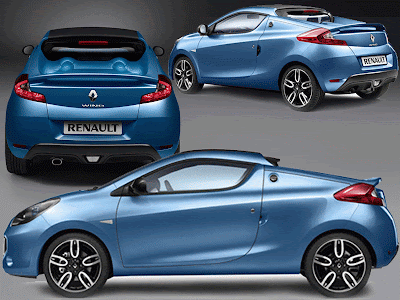
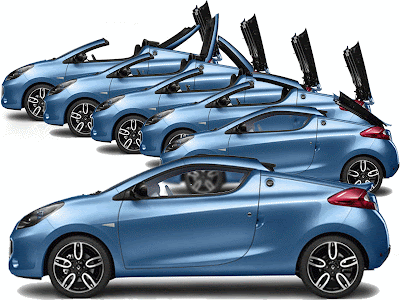
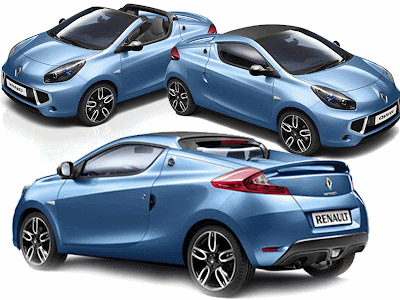
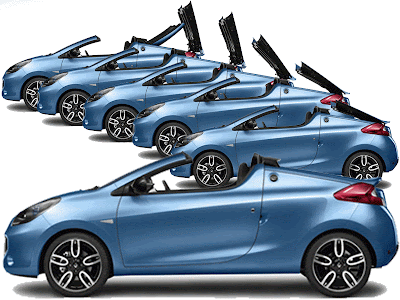
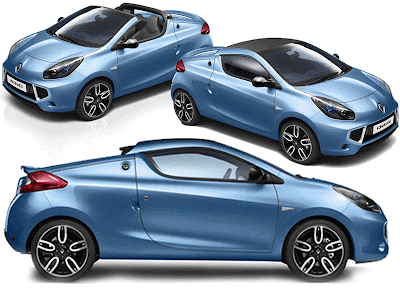
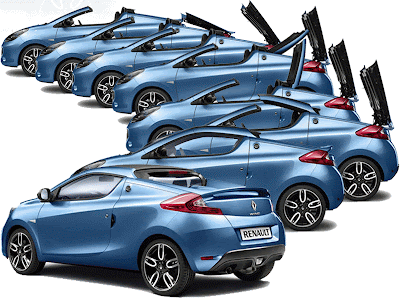
Renault announced its plans to unveil the brand-new Wind coupe-roadster at the upcoming Geneva Motor Show 2010 on 2 March. The 2011 Renault Wind is designed for two persons. Despite the fact that Renault pitches the car as a coupe-roadster, unlike other CC models with retractable hardtops, the Wind uses an exclusively innovative electric roof that rotates 180 degrees into the trunk, which is capable to open in just 12 seconds.
2011 Renault Wind Sport coupe-roadster 

Renault Wind brings a completely different take on a car for drivers who enjoy wind-in-the-hair motoring. Renault Wind is aimed at motorists who lust after a car that is not only distinctive and compact, but also convertible yet practical enough for everyday use.
2011 Renault Wind Sport coupe-roadster 

Advantages of this car is the only car of its class to provide just as much luggage space (270dm3 VDA) whatever the position of the roof.  The Renault Wind has a 3.83 metres in length which features a highly innovative way of opening up. The strictly two-seater model shares its platform and mechanical hardware with the Twingo, though at 3.830mm long, it's 230mm longer than the hatchback.
2011 Renault Wind Sport coupe-roadster 

The French automaker is keeping a tight lid on other details for now, but it is expected that the Wind will be offered with two of the Twingo's petrol engines, a 1.2-liter turbo with 100HP and a naturally aspirated 1.6-liter unit with 133HP.
2011 Renault Wind Sport coupe-roadster 

Although Renault Wind’s compact dimensions make it a nimble machine in and about town, it is the only car of its class to provide just as much luggage space (270dm3 VDA) whatever the position of the roof. True to Renault's brand signature "Drive the Change", Wind makes passion affordable for everyone.
 
2011 Renault Wind Sport coupe-roadster

Venturi Electric Sports Car Volage Concept

Venturi Electric Sports Car Volage Concept

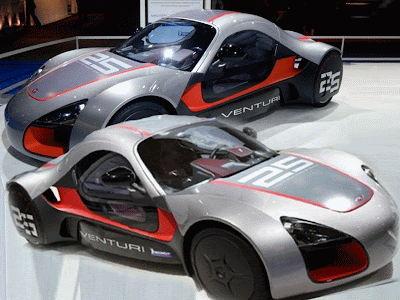
The result of close technological collaboration between Venturi Automobiles and Michelin, the Venturi Volage, marks a major step forward in the evolution of the Automobile. This new Venturi incorporates innovations which have enabled radical changes in terms of the vehicle’s architecture, style, dynamic behaviour and, more generally, the design of a modern vehicle. All these changes constitute several world premières which, with the presentation of the Venturi Volage, reinforce Venturi’s capability for constant innovation, as well as its position as the most advanced company in the field of electric vehicles.
Venturi Electric Sports Car Volage Concept

The Volage takes the electric sports car concept and really runs with it — the all carbon-fiber car is equipped with the first application we've seen of the Michelin Active Wheel, the compact unit using in-wheel electric drive motors is installed at all four corners with a suspension driven by a second set of e-motors. With 4 drive wheels with active suspension, the Venturi Volage has no equivalent. “Michelin Active Wheel” technology in fact incorporates 2 electric motors per wheel (1 for suspension and 1 for drive), ie. a total of 8 electric motors piloted in real time by spearhead electronics.
Venturi Electric Sports Car Volage Concept

Playing down the mechanical aspect in favor of electronics, close to the concept of a robot, this car belongs to a new era, the digital era. Thanks to a dashboard touch screen, the driver can configure the vehicle entirely as he wishes. This total control marks significant progress in terms of management, particularly of the energy stored in the car’s batteries: the driver can, for example, decide to give preference in certain cases to range rather than power, comfort rather than speed, an important factor for an electric car.
Venturi Electric Sports Car Volage Concept

The only part that the Venturi Volage shares with the Venturi Fétish is its carbon fiber bodywork. Developed by the Venturi Design Office, this body is still a unique concept worldwide, as it is the only one to have been specifically designed to be that of an electric car and thus carry batteries within its very structure. The ideal distribution of the Venturi Volage’s masses - 45% at the front, 55% at the rear – and its perfectly mastered weight of 1,075 kilos enable it to attain 100 km/hr (62 mph) in less than 5 seconds.
Venturi Electric Sports Car Volage Concept

A real demonstration of spearhead technology, the car presented in its world première is entirely operational and prefigures the production of a limited series of this model, scheduled as from 2012. Like the Venturi Fétish assembled in our workshops in Monaco, the Venturi Volage will be assembled by hand, in the form of very limited production. 
Venturi Electric Sports Car Volage Concept

The technological repercussions of these two cars positioned at the very top end of the market are to be found on other vehicles bearing the Venturi brand, enabling as many people as possible to benefit from the firm’s advances in the field of sustainable mobility.

2010 Heynsdyk 2500SF roadster from Dutch

2010 Heynsdyk 2500SF roadster 

Once in a blue moon in the automotive industry an unique vehicle comes to play. Such vehicle is 2500SF roadster from Dutch Heynsdyk. The Dutch have always had a penchant for the bizarre and unorthodox. From their unique 'coffee shops', to their individualist sense of style the people of Holland have always liked to go their own way. And that applies to car design as well. Spyker supercars are from Holland, and whether you love them or hate them, they really are very different in style to any other vehicle on the road.
2010 Heynsdyk 2500SF roadster 

A small independent builder in Eindhoven has given further weight to the argument by introducing this, the Heynsdyk 2500SF. Designed and engineered by Ronald Heijnsdijk, the car is based on the Porsche 944 platform and is essentially a kit car which can be ordered in component or fully finished form. However instead of being some sort of generic copy of another the vehicle, the 2500SF has a completely original style which is a mixture of hits and misses.
2010 Heynsdyk 2500SF roadster 

This is the Heynsdyk 2500SF from Holland: a bespoke body placed over the engine, electronics, and drivetrain of a Porsche 944. The design process took years to complete, but the decision to base the car on the 944 was made quickly. 100% galvanized, reliable and readily available. The substantially lighter body, in galvanized steel, takes weight down to 900 kilograms (1,980 pounds) while maintaining 50/50 weight distribution. There are six engine choices, from a basic 2.5-liter four-cylinder with 163 horsepower, to a 2.5-liter four-pot S-motor with a turbo. That one will get you 250 horsepower, and from 0 to 60 in six seconds. Top speed is limited to 250 kilometers per hour (155 miles per hour). The transmission is handled by a 5 speed manual which sends the power to the rear wheels.
2010 Heynsdyk 2500SF roadster 

Specification   
Year               : 2010
Engine             : four cylinder, 2.5 cylinder, Turbo or naturally aspirated
Transmission    : 5 speed manual, RWD
Max speed      : 155 mph (limited)
0-60 mph        : 6 seconds (turbo)
Horsepower    :    250 horsepower (turbo)
weight             : 900 kgs / 1,980 lbs

2010 Heynsdyk 2500SF roadster

The front angle is by far and away the worst area of the vehicle aesthetically. Here a random and mismatched assortment of lights and grilles come together to form a unique but far from pretty face. In profile things start to get better, and the proportions of the car are generally quite pleasing. The car shows off its best side when viewed from the rear. The well thought out mix of nicely sculpted roll bars, beefed up wheel arches, neat taillights and sloping decklid come together very well indeed.
You can buy the car as a kit or a finished product, and prices start at €14,750 ($20,798 U.S.) for the kit, or €36,995 ($52,158 U.S.) for a ready runner. Like its countrymate Spyker, what the car might lack in beauty it makes up for in unique and arresting looks.

Source: Heynsdyk.com

2010 Carlsson C25 Super-GT Concept a beautiful sports coupé

2010 Carlsson C25 Super-GT Concept

At the 2010 Geneva Motor Show the German tuning firm Carlsson, who unsurprisingly specialize in modding Mercedes-Benz models, will unveil the C25 - an insanely aggressive 753 horsepower monster.
2010 Carlsson C25 Super-GT Concept

Carlsson C25 is the first self-developed automobile from Carlsson and are presenting C25 at Geneva Auto Show this March. The concept of this Super-GT is based on the vision of combining maximum driving performance with an entirely new design and high exclusiveness. The result is a breathtaking and beautiful sports coupé with 753 hp in a limited edition of only 25 cars world-wide. Thereby, each automobile will be as individual as its future owner.
2010 Carlsson C25 Super-GT Concept

Carlsson presents an own developed automobile at this year’s Geneva Motor Show – the Carlsson C25 Limited Super-GT. The concept of this Super-GT is based on the vision of combining maximum driving performance with an entirely new design and high exclusiveness. The result is a breathtaking and beautiful sports coupé with 753 hp in a limited edition of only 25 cars world-wide.
2010 Carlsson C25 Super-GT Concept

The performance data of the six litre V12 Bi-Turbo is impressive. The high-performance aggregate with a motor management optimisation patented by Carlsson renders 753 hp (554 kW) and allows fast acceleration as well as smooth travels at lower speeds. Also responsible for the perfect performance evolvement is the elaborately developed stainless steel exhaust system with ends in four edgy pipes at the back. The power catapults the C25 with a torque of 1320 Newton metres at 3750 r.p.m. which is electronically limited to 1,150 Newton metres from 0 to 100 km/h in only 3.7 seconds and achieves a maximum speed of 352 km/h.
2010 Carlsson C25 Super-GT Concept

The Carlsson C25 Super-GT Concept also comes with an ultra-light and forged wheels 1/10 UL in the dimensions 9,5×20 and 12×20 inches have been especially designed for the C25 and are equipped with high performance tyres measuring 265/30 at the front and 325/25 at the rear live axle.