SRT8 Dodge Challenger Sport Car Limited-Edition


SRT8 Dodge Challenger Sport Car

The Dodge Challenger uses Chrysler's LX platform also found in the Dodge Charger and Chrysler 300C sedans, but with a decidedly more sporty exterior design and dimensions which help disguise its ample overall size.
The engine is connected to a five speed automatic transmission driving the rear wheels.
Power for the Dodge Challenger SRT8 comes from a front mounted 6.1 litre HEMI V8 engine which manages to produce 425 bhp @ 6200 rpm, and 420 lb-ft (310 Nm) of torque @ 4800 rpm.
The exterior of the production Dodge Challenger has remained relatively faithful to the design of the original concept Dodge Challenger from 2006, with just a few minor tweaks and details altered including the addition of a black lip spoiler under the front bumper, the removal of the Dodge crosshair grille, repositioning of the side indicators, repositioned fuel filler, redesigned taillights and a small matt-black rear spoiler.
SRT8 Dodge Challenger Sport Car

Dodge will offer the limited-edition 2008 Dodge Challenger SRT8 in three colors: HEMI Orange, Bright Silver Metallic and Brilliant Black Crystal Pearl Coat. Each two-door, rear-wheel-drive coupe will be produced with a numbered dash plaque and carbon fiberlike hood stripes.
Inside the 2008 Dodge Challenger many of the components are borrowed from the Charger and other Chrysler models, and the design has obviously been compromised in order to come in on budget.
Performance targets for the all-new 2008 Dodge Challenger SRT8 are impressive, and include a 0–60 mph time in the low 5-second range, 0–100–0 mph in less than 17 seconds, a ¼-mile elapsed time of less than 14 seconds, 60–0 mph braking distance of approximately 100 feet, and a skid pad performance of 0.88 g.

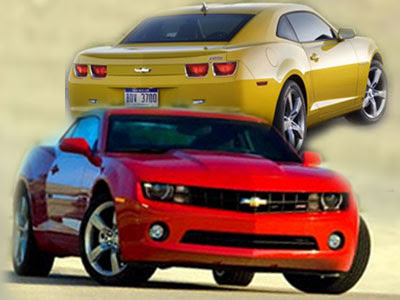
Chevrolet Camaro 2010 Modern Sports Car


Chevrolet Camaro 2010 Modern Sports Car

Release for the 2010 Chevrolet Camaro.
Built on GM’s new, global rear-wheel-drive architecture, the Camaro is offered in V-6- powered LS and LT models, as well as the V-8-powered SS. All models and powertrain combinations include fuel-saving six-speed transmissions.
Advanced powertrain technologies, including engines with direct injection and Active Fuel Management, enable a satisfying balance of exhilarating performance and good fuel economy.
Indeed, the 2010 Camaro exemplifies GM’s global development process. The design concept originated in the United States; engineering was directed by GM’s global rear- wheel-drive team in Australia; validation was conducted on roads around the world and assembly will take place at GM’s award-winning Oshawa facility in Canada.
Product highlights include:
Sleek styling with contemporary cues and 10 available exterior colors
LS and LT models offered with an advanced, 3.6L direct-injected V-6 engine with variable valve timing and a choice of six-speed manual or automatic transmissions
SS model offered with 6.2L V-8 – including fuel-saving Active Fuel Management on automatic-equipped combinations – and a six-speed manual transmission
Four-wheel independent suspension system, including a 4.5-link rear suspension
Variable-rate power steering with the rack mounted forward of the front axle for greater driver feel
Four-wheel disc brake systems standard on all models, including four-piston Brembo calipers on SS models
StabiliTrak stability control system and traction control standard on all models
Competitive/Sport modes for the stability system offered on SS models, including launch control on SS models equipped with the six-speed manual transmission

XM Satellite Radio
Additionally, details such as frameless door windows with automatic indexing glass contribute to the overall feeling of quality, substance and technical prowess.
With a design that is very faithful to the original concept, the 2010 Camaro is a 21st century sports car that acknowledges its heritage. A long front dash-to-axle and short rear deck give the Camaro classic proportions, while a sleek windshield profile, wheels pushed to the corners and muscular fender forms are modern elements that reinforce its advanced engineering – and give the car a decidedly aggressive stance.
Elements such as a forward-V shape at the front of the car and “gills” in the rear quarter panels are distinctly Camaro cues, as are the broad rear fender “shoulders.” Those elements make the new Camaro instantly recognizable, but their execution is smoothly integrated into the contemporary exterior form. A family of large, 18-, 19- and 20-inch wheels also contributes to the Camaro’s modern appearance.
A well-executed balance of heritage, modern design and attention to detail also characterizes the Camaro’s interior. A pair of deeply recessed instrument binnacles that
feature round gauges in square housings is a nod to classic Camaros, while an available ambient light package offers advanced LED light pipe technology to give the cabin a distinctive and inviting glow. Cloth upholstery is standard; heated leather-appointed seats are available.
Details such as large, chrome-trimmed controls, low-gloss surfaces and premium fabric or acrylic appliqués convey a richness that is unprecedented in previous Camaro models – and challenge its contemporary competitors. More great detail is evidenced in the available center-console gauge cluster, which takes its cue from a similar option on 1969 Camaros. It displays oil temperature, oil pressure, state-of-battery and transmission fluid temperature, all highlighted with modern LED backlighting.

Powertrains
An advanced, efficient 3.6L direct-injected V-6 with variable valve timing is standard on LS and LT models. direct injection technology helps the engine deliver more power through increased efficiency, while maintaining fuel economy and lowering emissions. That means less fuel is consumed and lower emissions generated – including a 25- percent drop in cold-start hydrocarbon emissions.
The Camaro’s 3.6L engine also employs variable valve timing to optimize performance and fuel economy across the rpm range. It is rated at an estimated 300 horsepower (224 kW) and 273 lb.-ft. of torque (370 Nm). A six-speed manual transmission is standard with the 3.6L engine; a Hydra-Matic 6L50 electronically controlled six-speed automatic, with TAPshift control, is available.
The high-performance Camaro SS is equipped with a powerful 6.2L V-8, with a choice of a six-speed manual or six-speed automatic transmission. Standard, manual transmission-equipped models receive the LS3 engine, estimated at 422 horsepower (315 kW) and 408 lb.-ft. of torque (553 Nm). The LS3 debuted on the 2008 Corvette and uses high-flow cylinder heads based on the Corvette Z06’s LS7 engine to enable great low-end torque and high-rpm power. It is paired with a TR6060 six-speed transmission.
A new, L99 V-8 engine is used on automatic transmission-equipped SS models. It is based on the LS3 and carries all of its high-performance design features, but also includes GM’s fuel-saving Active Fuel Management feature. It enables the engine to run on only four cylinders during light-load driving conditions, such as highway cruising, to improve fuel economy. The V-8 is estimated at 400 horsepower (299 kW) and 395 lb.-ft. of torque (535 Nm); and it is matched with a Hydra-Matic 6L80 six-speed transmission. This combination delivers an estimated 23 mpg on the highway.


AC Superblower Ford V8 engine Sport Car


AC Superblower Ford V8 engine Sport Car

The AC Superblower is a supercharged version of the famous AC Cobra, power comes from a 355 horsepower, 5 litre, Ford V8 engine.


Along with the new engine package comes a re-designed retro-look interior for the Superblower. This features new circular Smiths instruments, mounted

on a central binnacle, new leather seats and new carpeting. There is a warning light cluster in front of the driver and a new steering wheel. There

is a stylish, hand-tooled aluminium gear knob and the startling yellow show car features a colour-coordinated instrument binnacle.

Cabriolet S5 Audi Sport Car Coupe


Cabriolet S5 Audi Sport Car Coupe

The Audi S5 Cabriolet is powered by a supercharged 3.0 litre V6
The Audi S5 Cabriolet which was revealed in December 2008 is the replacement car for the S4 Cabriolet, a model which will be discontinued.

Unlike the S5 Coupe which is powered by a 4.2 litre V8, the S5 Cabriolet uses a supercharged 3.0 litre V6. After the 2010 model year so will the coupe, but the cabriolet starts out with this unit.
Cabriolet S5 Audi Sport Car Coupe


The engine develops 333 hp and 325 lb-ft of torque. The transmission is handled by either a 6 speed tiptronic gearbox or a 7 speed double-clutch automatic. The quattro all-wheel-drive system features a 40/60 front/rear torque split.

Like the S5 Coupe the S5 Cabriolet features cosmetic upgrades which differentiate it from the standard A5 Convertible. The radiator grille is finished in platinum grey and fitted with vertical chrome inlays. The front and rear bumpers are modified and have an exaggerated design with more aggressive air inlets. The windscreen surround and mirror housings are finished in an aluminum-look material which immediately identifies the model as belonging to the Audi 'S' family.

Inside the Audi S5 Cabriolet are a pair of sports seats up front and a sports steering wheel. The cloth convertible top features Audi Acoustic Roof technology for a quiet interior.

Aston Martin Rally GT Racing V8 Vantage


Aston Martin Rally GT V8 Vantage

The Aston Martin Rally GT, based on the Aston Martin V8 Vantage, was developed by Aston Martin Racing and automotive engineering specialists Prodrive (see Prodrive P2) for use in rally racing.

The Aston Martin Rally GT was extensively engineered by Prodrive, and like the DBRS9 based on the Aston Martin DB9, the Rally GT is based on a standard road car's chassis. However the Rally GT has been fitted with a Prodrive rollcage, a tuned and more responsive version of the standard car's 4.3 litre V8, and new competition Eibach springs and adjustable EXE-TC dampers. The 6-speed transmission is the same unit found in the road car, but it can be upgraded to a close ratio dog engagement gearbox specifically developed for the Aston Martin Rally GT.

Z4 Roadster BMW Sport Car.


Z4 Roadster BMW Sport Car.

2010 BMW Z4 Roadster is the first all-new, top-to-bottom redesign of the Z4 model which was originally launched in 2002.
The 2010 Z4 has a sleeker profile and more subtle "flame surfacing" body lines than the previous model. In general the car has a more balanced and matured appearance to it. That's not to say the roadster has lost any of its visual appeal, it's just been refined and tweaked to fit better with the current BMW styling direction.
The front end of the 2010 BMW Z4 has undergone the most obvious transformation. The headlights are thinner and sweep back further into the wheel arches, and the trademark BMW kidney grilles have been elongated to better match the headlights. Down the sides the controversial styling slash which intersected the fender mounted BMW badge has been replaced by a more conventional panel. The BMW badge is now fitted just forward of the doors and adjacent to the side indicators which are cleverly integrated into the metalwork.
Unlike the original Z4 Roadster which used a fabric roof, the 2010 model is fitted with a retractable metal roof which folds away neatly into the rear storage area. 20 seconds is all it takes for the roof to electronically raise or lower itself.
The 2010 BMW Z4 is offered with a choice of three different engine options. The Z4 sDrive23i model is equipped with a 2.5 litre inline 6 cylinder which develops 204 horsepower. The Z4 sDrive30i is fitted with a 258 horsepower / 228 lb-ft of torque naturally aspirated 3.0 litre 6 cylinder. The top level Z4 is the sDrive35i version which is powered by a twin-turbocharged, 3.0 litre, inline 6 cylinder which pumps out 306 horsepower. With this engine the Z4 can hit 62 mph in just 5.1 seconds. The Z4 can be fitted with either a 6 speed manual gearbox or a 7 speed dual-clutch transmission.

Shelby GT500KR Ford Mustang Sports Car (King of the Road)


Shelby GT500KR Ford Mustang Sports Car

King of the Road
The 2008 Ford Mustang Shelby GT500KR is a limited edition performance model limited to just 1000 units. The launch of the GT500KR at the 2007 New York International Auto Show was designed to coincide with the 40th anniversary of the original 1968 Shelby GT500KR.
The bulging vented hood, styled after the original, is secured by a pair of stainless steel, twist-down hood pins. The composite front valance houses a pair of chrome-trimmed, functional brake ducts to cool the large 14-inch, vented Brembo front brakes.
The Ford SVT-engineered 5.4-liter supercharged V-8 under the GT500KR's hood is treated to a Ford Racing Power Upgrade Pack that boosts horsepower to an estimated 540 and torque to 510 ft-lbs, thanks to revised ignition and throttle calibration and a cold air intake system that replaces the stock unit.
Shelby GT500KR Ford Mustang Sports Car

Power is delivered to the rear wheels of the GT500KR through a Tremec TR6060 six-speed manual transmission and 3.73:1 rear axle ratio, upgraded from the standard GT500's 3.31:1. Gear selection is courtesy of an all-new Ford Racing short-throw shifter making its debut on the KR. Topped with a white ball, the new shifter is 25 percent shorter than the unit on the GT500 providing for crisper, sharper shifts.
Ford SVT, Ford Racing and Team Shelby worked together to develop the GT500KR's suspension tuning. Based on initial work by Ford Racing and the team at Shelby, often at Shelby's own facility on the grounds of Las Vegas Motor Speedway, Ford SVT chassis engineers will apply fine tuning techniques to prepare it for the streets. The Shelby GT500KR will feature unique spring rates, dampers, stabilizer bars, and strut tower brace, all designed specifically for the KR, to deliver the precision handling package.